Cement Testing Services & Laboratory
Professional laboratory testing to evaluate 3, 7, and 28-day compressive strength, Vicat initial and final setting times, Le Chatelier soundness, Blaine fineness, and chemical composition for OPC, PPC, and blended cements.

CIVIL & BINDING MATERIAL TESTING
Cement Testing Services & Laboratory
Professional laboratory testing to evaluate 3, 7, and 28-day compressive strength, Vicat initial and final setting times, Le Chatelier soundness, Blaine fineness, and chemical composition for OPC, PPC, and blended cements.
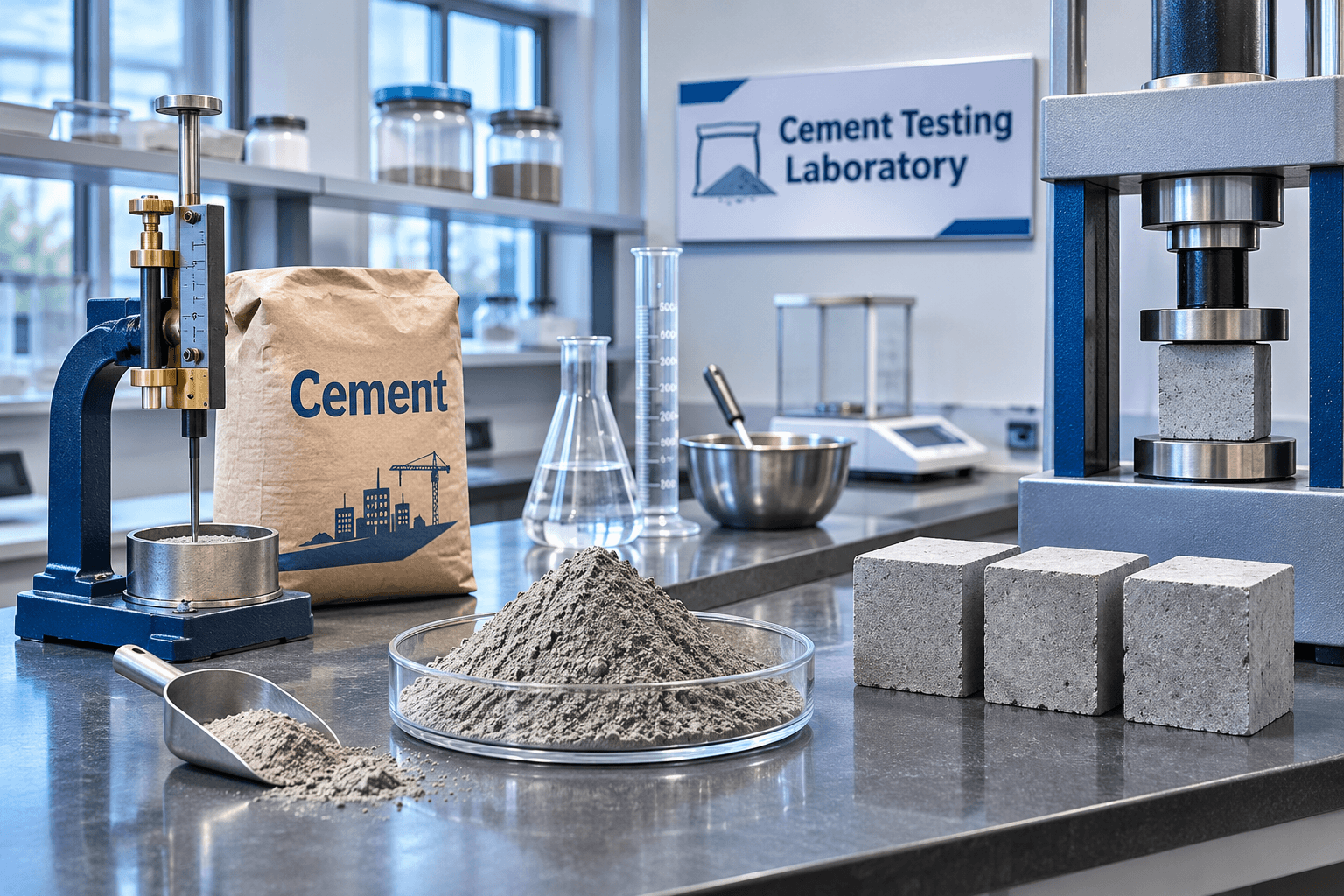
Professional Cement Quality Evaluation Laboratory
Our laboratory provides reliable cement testing services to evaluate the physical, mechanical, and chemical properties of hydraulic cements used in civil infrastructure, commercial construction, and ready-mix concrete production.
We conduct standardized tests including compressive strength of standard mortar cubes, Vicat setting time, Le Chatelier soundness, Blaine fineness, and loss on ignition. These tests help contractors, developers, and cement manufacturers ensure quality compliance, preventing delayed expansion, setting failures, and structural strength deficits.
Reliable
Testing Services
Advanced
Testing Equipment
Quality
Test Reports
Our Comprehensive Cement Testing Services
Standardized physical, mechanical, and chemical evaluations performed under controlled laboratory conditions.
Compressive Strength (3, 7, 28 Days)
Evaluates mortar crushing strength on standard 70.6 mm cubes prepared with standard reference sand at 3, 7, and 28-day curing milestones using calibrated compression testing machines.
Initial & Final Setting Time
Measures paste stiffening time using the Vicat needle apparatus to confirm adequate placement time (initial set ≥ 30 min) and complete hardening without delay (final set ≤ 600 min).
Soundness Test (Free Lime & Magnesia)
Determines volume stability and delayed expansion using the Le Chatelier split-ring boiling method (limit ≤ 10 mm) and autoclave expansion test (limit ≤ 0.8%) to prevent destructive cracking.
Fineness by Blaine Air Permeability
Measures the specific surface area per unit mass of cement using Blaine apparatus (≥ 225 m²/kg for OPC; ≥ 300 m²/kg for PPC) alongside standard 90-micron dry sieve residue checks.
Normal Consistency Determination
Finds the precise water-to-cement ratio (P%) required for a standard paste enabling the 10 mm Vicat plunger to penetrate 5–7 mm from the bottom, essential for all physical tests.
Chemical Composition & LOI Analysis
Analyzes critical chemical markers including Loss on Ignition (LOI ≤ 5.0%), Insoluble Residue (IR ≤ 5.0%), Magnesia (MgO ≤ 6.0%), and Lime Saturation Factor (LSF) using laboratory chemical analysis.
Density & Specific Gravity Test
Measures true particle density using calibrated Le Chatelier flasks and non-reactive kerosene (typically 3.10–3.15 g/cm³ for OPC) for concrete mix design yield calculations.
Heat of Hydration Evaluation
Evaluates the exothermic heat released during cement hydration using solution calorimetry methods to prevent thermal cracking in massive raft foundations and dams.
Drying Shrinkage of Mortar
Evaluates length changes in prismatic mortar specimens exposed to cyclic drying to predict and minimize shrinkage cracking in structural floor slabs and bridge decks.

Cement Testing for Structural, Infrastructure & Commercial Works
Our cement testing services support high-rise residential construction, highway bridges, ready-mix concrete batching plants, and precast manufacturing. Independent testing ensures that every batch possesses the proper setting window, volume stability, and load-bearing capacity necessary for enduring concrete structures.
High-Rise Framing
OPC 53 Grade Concrete
Marine & Foundations
PPC & Slag Durability
Ready-Mix Concrete
Batch-to-Batch Quality
Precast & Pavers
Early Compressive Gain
Our Cement Testing Process
Intake & Check
Inspection of sealed packages, moisture exclusion check, and laboratory batch logging.
Consistency (P%)
Vicat plunger penetration test to establish standard water percentage for all test pastes.
Setting & Soundness
Vicat needle penetration for set times and boiling Le Chatelier split-cylinder soundness.
Cube Casting & Curing
70.6 mm mortar cubes cast on standard vibrating tables and cured in controlled water tanks.
Crushing & Report
Crushing at 3, 7, and 28 days on calibrated UTM with verified test reports issued.
Sample Submission Guidelines for Cement Testing
Follow these technical guidelines when preparing and dispatching cement samples to our laboratory facility in Noida.
Sample Quantity
Submit 8 kg to 10 kg of representative cement for complete physical and chemical testing. For mortar compressive strength alone, submit at least 5 kg.
Airtight Packaging
Seal immediately in double-layered, heavy-duty polythene bags tightly tied to exclude atmospheric moisture and prevent pre-hydration lumps.
Traceability Details
Label clearly with manufacturer name, brand, cement type/grade (e.g., OPC 53, PPC), week and year of manufacture, and site batch reference.
Safe Transport
Ensure sample packages are securely sealed and protected from rain, dampness, and moisture during transport to our laboratory.
Why Choose MQTL for Cement Testing?
Accurate physical, mechanical, and chemical evaluations backed by experienced materials testing engineers.
Calibrated Equipment
Testing executed on automated compression machines, Vicat apparatus, and Blaine permeability meters calibrated to national standards.
Documented Protocols
Every test method follows validated laboratory standard operating procedures and technical quality protocols.
Milestone Reporting
Interim reports for consistency, setting time, and 3/7-day strength, followed by final 28-day verified laboratory reports.
Engineering Expertise
Direct consultation with qualified civil materials engineers to interpret test results and mix design parameters.
Need Reliable Cement Quality Testing?
Connect with our testing experts in Noida to schedule specimen testing, request customized quote batches, or obtain verified laboratory test reports.
Frequently Asked Questions About Cement Testing
Technical answers regarding compressive strength milestones, setting times, soundness, and sample handling.